


Worship Begins with God: The Power of Noticing Him in a Distracted World
Any serious conversation on worship needs to begin with the one truth that reshapes everything else: worship does not begin with us.
It’s easy to assume worship starts when the band hits the first chord, when we open our Bible, or when we decide to pray. But at the deepest level, worship begins with God. He reveals Himself first. He speaks first. He shines first. Before humanity ever lifted a single song, before any lead worshipper stepped onto a platform, and long before the first prayer was whispered, God was already there: holy, beautiful, worthy, loving, powerful, and good.
So the movement of worship is not mainly we try harder, but God reveals Himself -> we notice Him -> worship awakens and overflows. That is where we have to start. True worship begins when we see Him rightly. It starts when our hearts become aware of His presence. And in a distracted world, simply noticing God can feel like a spiritual act of rebellion (a holy one, of course).

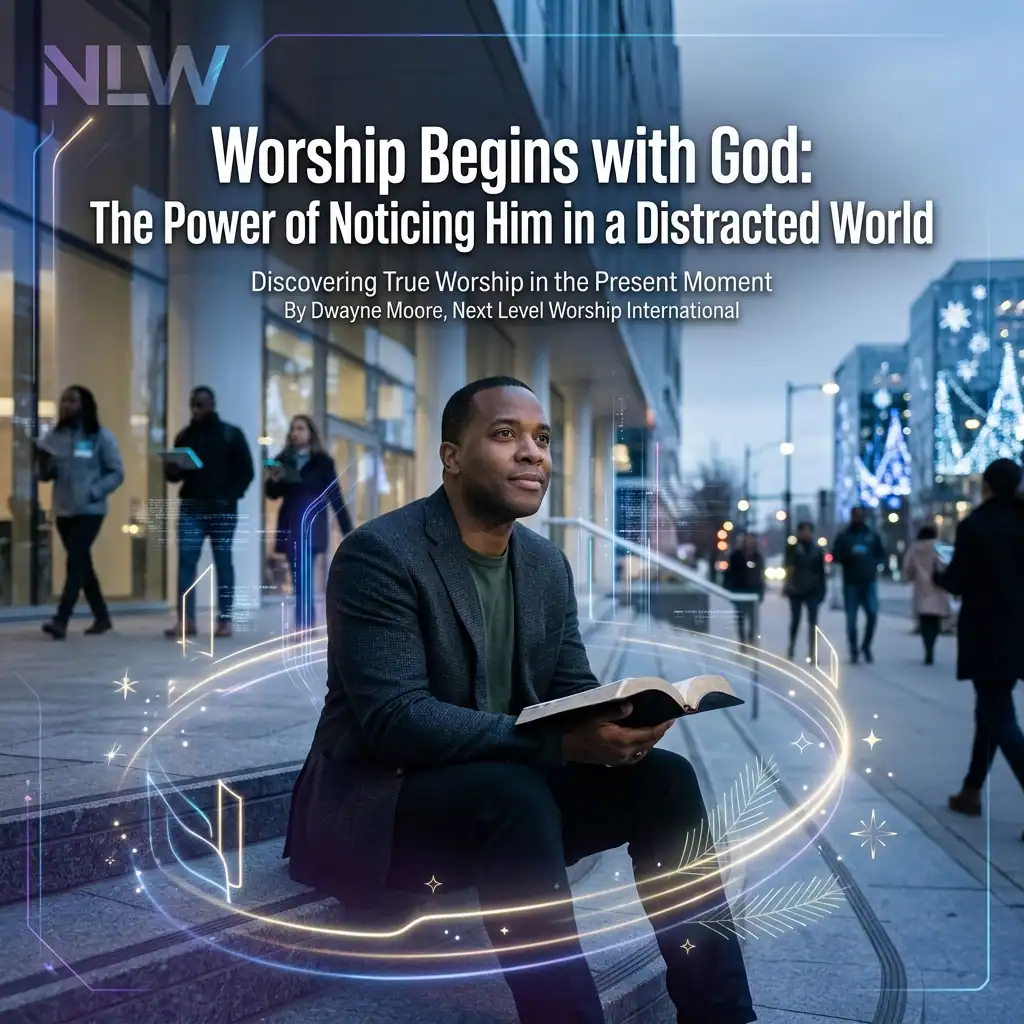
A serene moment of quiet reflection, where the noise of the world fades as the heart awakens to God's presence.
The Great Battle for Your Attention
We often think the greatest spiritual battle is between "good and evil" in a broad sense. But on a Tuesday afternoon or a frantic Monday morning, the battle is often much quieter. It is the battle for our attention.
Modern life is designed to keep us distracted. We are surrounded by noise, pressure, schedules, and the constant hum of our phones. Most of us wake up and immediately reach for notifications, news, or our to-do lists. We move from screen to screen: phone to laptop, laptop to dashboard, dashboard to television, television back to phone: and often call that "normal life." Our minds are crowded before our souls have even had a chance to grow quiet enough to notice Him.
And that matters more than we may realize. A steady stream of alerts, headlines, breaking news, text messages, social feeds, and endless content doesn't just exhaust us mentally; it can dull us spiritually. We don't suddenly stop believing in God, but we do slowly stop noticing Him. Our inner world gets trained to react quickly, scroll constantly, and skim everything, including the sacred. We become "spiritually unfocused."
This isn't just a "modern problem"; it’s a spiritual one. When we live in a state of constant distraction, our spiritual sensitivity starts to weaken. The heart loses its attentiveness. The conscience gets noisier. Wonder becomes harder to access. This is why whole-life worship is so critical: it’s the intentional practice of bringing God back into the center of our gaze, not just on Sunday mornings, but in every moment.
Awakening to His Presence
Throughout Scripture, we see that worship almost always begins when someone suddenly becomes aware that God is here.
Think about Moses and the burning bush. He was just doing his job, tending sheep, when he noticed something unusual. He had to "turn aside" to see it. Think about Jacob, who awoke from a dream and exclaimed, “Surely the Lord is in this place, and I did not know it” (Genesis 28:16).
Look at Isaiah in the temple. In Isaiah 6, his whole world changed because he saw the Lord. He didn't manufacture an emotional experience or perform a ritual; he encountered a revelation. He became aware of the holiness and majesty of God, and that awareness changed him.
That movement matters. First came revelation: "I saw the Lord sitting upon a throne, high and lifted up" (Isaiah 6:1). Isaiah's worship did not begin with his effort; it began with God's self-disclosure. Then came awareness. Once God was revealed, Isaiah became profoundly aware of where he was, what was happening, and Who he was standing before. The room, the seraphim, the shaking thresholds, the cry of "Holy, holy, holy" all pressed the reality of God's presence into his soul.
And from that awareness came an inward response. Isaiah did not first volunteer for ministry. He first fell under conviction. "Woe is me! For I am lost; for I am a man of unclean lips" (Isaiah 6:5). In other words, when he saw God rightly, he saw himself rightly. Revelation led to awareness; awareness led to humility; humility opened the door for cleansing and surrender.
Only then did the movement become outward obedience. After the coal touched his lips and grace met his need, Isaiah heard the Lord ask, "Whom shall I send, and who will go for us?" And then he answered, "Here am I! Send me" (Isaiah 6:8). That is the pattern: Revelation -> Awareness -> Inward Response -> Outward Obedience. God reveals Himself. We become aware. Our hearts are convicted and cleansed. Then our lives move outward in willing obedience.
The "Tea Kettle" of Worship
At Next Level Worship, we often talk about the ministry of worship as something that happens from the inside out. To help illustrate this, we like to use the analogy of a tea kettle.
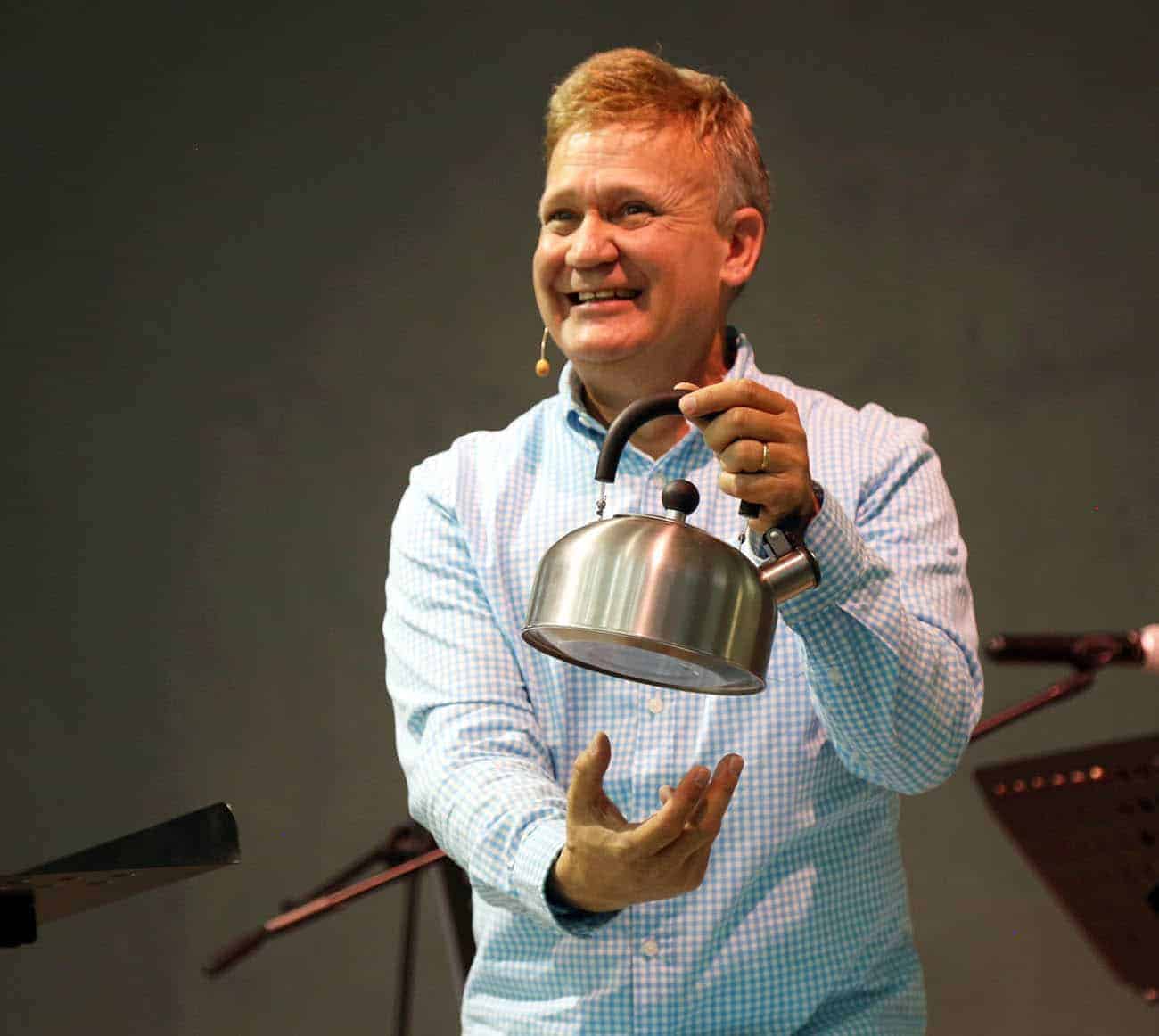
Imagine a tea kettle sitting on a cold stove. Nothing is happening. It looks still, silent, uneventful. But once you apply heat, things start to change. At first, you can't see the change from the outside. The water is getting hotter, pressure is building, and movement is happening internally. Molecule by molecule, the inside is being altered long before the outside makes any announcement. Eventually, what is happening inside can no longer stay hidden. Steam rises, a whistle blows, and overflow appears.
Worship works the same way. When our hearts are warmed by the fire of God’s goodness and holiness, something begins to move inwardly before it is ever expressed outwardly. Love awakens. Gratitude rises. Awe deepens. Tears sometimes come. Silence sometimes becomes holy. A bowed head, a lifted hand, a song, an act of service, a prayer for someone in need: these outward responses are often the "steam" of something God has already been doing deep within us.
That is the Inward to Outward flow. The hidden life with God becomes visible over time. Internal affection becomes external expression. Private revelation becomes public obedience. We don't force the whistle; we stay near the fire.
If we try to start with the "steam" (the outward expression) without the internal "heat" (awareness of God), our worship becomes hollow and performative. This is why some services feel like they’re just going through the motions, while others feel alive. One is trying to imitate overflow; the other is responding to a real, internal fire.
A Personal Awakening: Romans 8
I (Dwayne) remember experiencing this internal fire for the first time when I was fourteen years old. I had started getting really hungry for the Word, highlighting my Bible until the pages were practically neon. One night, I was lying on my bed reading the end of Romans 8.
As I read Paul’s words: that nothing can separate us from the love of God in Christ Jesus, not death, life, angels, or powers: something shifted. The Holy Spirit illuminated my heart. I didn't just understand it intellectually; I became overwhelmingly aware of His love for me. The words moved from the page into my spirit. What had been truth in my mind became fire in my heart.
I didn’t need a band or a light show. I was just lying on my bed, weeping, because awareness had become affection. That is the movement we keep coming back to: inward before outward. First, God made His love real to me inwardly. Then the response came outwardly. That night, I walked over to the piano and wrote my very first worship song. Worship overflowed because something had happened inwardly. The song was not an attempt to create a moment; it was the natural expression of a moment God had already created in me.
Inward, Upward, and Outward
We believe that true worship follows a specific movement. We call it Inward, Upward, Outward.

- Inward: The hidden turning of the heart toward God. It’s awareness, surrender, and humility.This is where worship really begins: beneath the surface, in the inner life. Paul told the church in Colossians 3:16, “Let the word of Christ dwell in you richly.” That phrase dwell richly matters. It means we are not just giving God a passing thought or a quick Sunday acknowledgment; we are making room for His Word, His presence, and His rule to settle deeply in us.This is also where the old idea of worth-ship becomes helpful. Worship is about assigning worth. It is about giving our deepest attention and affection to God instead of handing that place over to lesser things. And yes, sometimes those “lesser things” are not obviously sinful. They can be good gifts that slowly become functional idols: relationships, approval, ministry success, comfort, even our own image. If something captures our heart more than God, it starts competing for the place only He should hold.That is why the warning in Amos 5 is so sobering. God said, “Take away from Me the noise of your songs; to the melody of your harps I will not listen” (Amos 5:23). That is strong language, but it is loving language too. He was confronting worship that sounded spiritual on the outside while the heart and lifestyle were disconnected from Him. In other words, God is not looking for more religious noise; He is looking for real affection, real surrender, and real obedience.And if we’re honest, many of us can slip into the Sunday-only worship trap. We sing passionately for an hour, then spend the rest of the week distracted, anxious, self-driven, or emotionally attached to a dozen competing loves. But worship was never meant to be a weekly event we attend. It is a daily posture of attention. It is the steady inward choice to say, “Lord, You are worthy of my love, my focus, my trust, and my obedience.”
- Upward: The response of praise and adoration directed toward the Lord.Once the heart is awakened inwardly, worship naturally begins to move upward. This is where inward affection becomes visible praise. We sing. We speak His greatness. We bless His name. We physically respond because we are not disembodied souls; God made us as whole people, and our bodies often join what our hearts are feeling.Scripture is full of physical expressions of worship. We sing because praise should be heard. We kneel because humility should sometimes be embodied. Think of the Wise Men in Matthew 2:11: “And going into the house, they saw the child with Mary His mother, and they fell down and worshiped Him.” They did not just admire Jesus internally; they bowed before Him. Psalm 47:1 says, “Clap your hands, all peoples! Shout to God with loud songs of joy!” That kind of praise is joyful, wholehearted, and unashamed.In fact, there are 8 biblical ways to praise, and each one helps us remember that worship is more than mental agreement. It can involve singing, kneeling, clapping, lifting hands, shouting, playing instruments, dancing, and bringing spoken thanksgiving before the Lord. Not every person expresses worship the same way in every moment (and that’s okay), but the Bible clearly gives us permission to respond with our whole selves.
- Outward: The overflow of that worship into our daily lives, our service to others, and our witness to the world.Worship never stops at the sanctuary door. Colossians 3:17 says, “And whatever you do, in word or deed, do everything in the name of the Lord Jesus, giving thanks to God the Father through Him.” That means our worship moves outward into staff meetings, counseling conversations, family dinners, neighborhood relationships, errands, emails, and everyday interruptions. If Jesus is Lord, then all of life becomes a place where worship can be expressed.This is where we begin to live like His ambassadors. We represent His heart in the world around us. We carry His presence into ordinary moments. We respond to people with grace, truth, generosity, and courage. Outward worship is not just about what we do at church for God; it is about how we live for Him in front of other people.And this connects beautifully to the Great Commandment. Jesus said, “‘You shall love the Lord your God with all your heart and with all your soul and with all your mind.’ … ‘You shall love your neighbor as yourself’” (Matthew 22:37-39). Notice the flow: love for God overflows into love for people. So outward worship includes sharing our faith, serving people in practical ways, helping those in need, encouraging the discouraged, and treating our neighbors as image-bearers worthy of dignity and care. When our worship is real inwardly and rightly directed upwardly, it will show up outwardly in love.
As a church leader, it is vital to remember that God has always cared about the heart more than the performance. Jesus warned us about people who "honor Me with their lips, but their heart is far from Me" (Matthew 15:8). That is one of the clearest reminders in all of Scripture that outward religious activity can exist without inward reality. We can say the right things, sing the right songs, stand at the right moments, and still be emotionally distant and spiritually disengaged.
That is why heart worship matters so deeply to God. Proverbs 4:23 says, "Keep your heart with all vigilance, for from it flow the springs of life." The heart is not a side issue in worship; it is the source. It is the wellspring. What flows outward in our words, leadership, songs, attitudes, and relationships is usually revealing what is happening inwardly. God is not impressed by polished religious performance if the inner life is neglected. He is after truth in the inward being.
Our goal, then, is not merely to help people participate externally, but to lead them into a place where their "lips" and their "hearts" are in total alignment. This is the essence of Pure Praise.
Practicing the Pause
So how do we learn to notice Him in a noisy world? We pause.
That sounds almost too simple, but that’s part of the point. In the middle of a distracted day, we stop for a moment, breathe, and remember that God is present. We interrupt the scroll, the rush, the mental clutter, and turn our attention back to Him. Psalm 16:8 says, “I have set the Lord always before me.” Not occasionally. Not when the service starts. Always.
A simple rhythm can help: Pause. Notice. Respond.
- Pause: Stop for a moment.
- Notice: Remember that He is here.
- Respond: Whisper a prayer, a thank You, or a simple expression of praise.
Learning to notice God is often quiet and repeated. But those small returns matter more than we think. Over time, they train the heart to become attentive again.
He Put a New Song
In Psalm 40:3, David writes, “He put a new song in my mouth, even praise to our God.”
Notice the first two words: "He put." God initiates. He draws us. He reveals Himself. Our job is simply to be attentive enough to notice when He’s moving.
That is the heartbeat of this chapter. Worship begins with God. He reveals His glory, His love, His holiness, His nearness. We notice Him. And when we do, worship awakens and overflows. Like the steam from the kettle, what God starts inwardly cannot stay hidden forever.
Worship begins with God. So before we sing, serve, lead, or respond, we must learn to notice Him.
This blog post was created with the assistance of AI.
Paul Baloche Answers Worship Leaders’ Questions During Webinar
Today I sat in on a live and interactive webinar with song-writer and worship pastor, Paul Baloche
Worship Is the Fuel of Missions
I am reading a thought-provoking book by Gary Wright, who is a member of my church’s praise

Praise is Universal
Praise is universal. If we could fly over the “plains of praise,” we would see many land
Leave a Reply
You must be logged in to post a comment.