


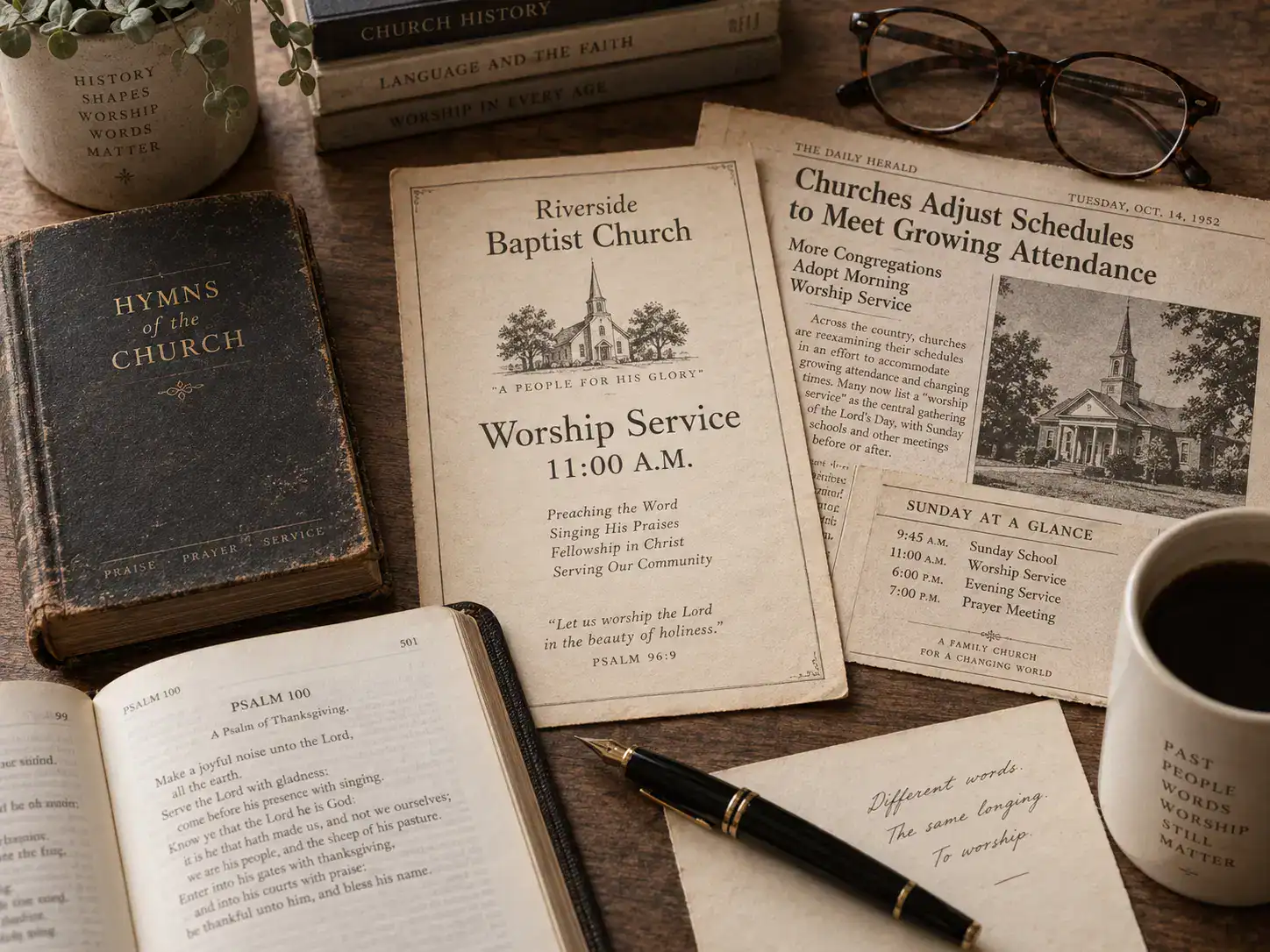
When Did Worship Become Something We Attend?
How “Worship Service” Became the Name of an Event
By Dwayne Moore
Part One of More Than a Service: Recovering a Biblical Vision of Worship
Ask the average Christian, “What time is worship at your church?” and he or she will probably give you a time.
- “Eleven o’clock.”
- “Sunday morning at 9:30.”
- “We have two worship times, 9:00 and 10:45.”
There is nothing unusual about those answers. We all understand what they mean. We are talking about the time when the church gathers to sing, pray, hear Scripture and preaching, give, fellowship, and respond to God together.
But perhaps that is precisely why the question is worth slowing down over. How did worship become something we attend at a particular time? How did a biblical reality involving our response to the worth and glory of God become the name of an event on the church calendar? And what might that language have quietly taught generations of Christians about worship: even when no one intended to teach it?
The phrase is not the problem
Before going further, let me be clear about what I am not suggesting.
I am not arguing that churches should stop using the phrase worship service. I am certainly not criticizing the gathered worship of the church, congregational singing, contemporary worship music, worship teams, preaching, or the faithful work pastors and worship leaders put into planning Sunday gatherings.
The church needs to gather. And when we gather, we really do worship.

In fact, as we will discover in the next article, the words worship and service belong together in a profoundly biblical way. The problem is not that Christians connected those two ideas.
The problem comes when we begin to confine that connection to one service, in one place, on one day of the week.
The problem is not Sunday worship.
The problem is Sunday-only worship.
That distinction matters.
“Service” is an old worship word
The religious use of the word service is much older than the modern expression worship service.
The Oxford English Dictionary traces service as a term for Christian liturgy and public religious observance back into Old English. Long before the exact compound worship service became common, Christians were speaking of divine service, church service, the service of God, and related expressions. The OED’s current historical record, interestingly, lists worship service itself from 1929. [1]
That does not mean Christians suddenly invented the concept of service in the twentieth century. Quite the opposite. The language of service has deep roots in Christian worship.
What seems comparatively recent is the familiar two-word label: worship service.
And we can actually push documented usage a little earlier than the OED’s current citation.
On March 1, 1924, the Cleburne Morning Review in Texas printed the weekly schedule for Central Church of Christ. Bible school was at 9:45. Then came a “praise and worship service,” which included preaching and the Lord’s Supper. [2]
A year later, an Oregon Methodist church announcement read: “Sunday school will be followed by worship service at 11.” [3]
We should be careful about what such evidence proves. It does not tell us that someone invented the term in 1924. Nor does the OED’s 1929 citation mean nobody used it before then. Historical dictionaries and digitized archives can show us surviving examples; they normally cannot identify the first time a phrase was ever spoken.
Nor have I found evidence that a particular theologian, denomination, council, or pastor deliberately coined worship service as a new theological category. The expression seems to have entered Christian vocabulary much more naturally than that. And that may be part of the story.
Before “worship service,” the language was broader
Earlier Protestant usage provides an interesting contrast.
The Westminster Assembly’s 1645 document was called The Directory for the Publick Worship of God. Its sections deal with Scripture reading, prayer, preaching, baptism, the Lord’s Supper, singing, and the assembled response of God’s people. When describing the opening prayer, the Directory even speaks of seeking God’s acceptance “in the whole service then to be performed.” [4]
Worship was not simply one segment within the service. The whole gathering was being rendered toward God.
More than a century later, John Wesley prepared an adaptation of the Book of Common Prayer for the Methodists in the newly formed United States. Its 1784 title was The Sunday Service of the Methodists in North America. Again, service was already sufficient language for the gathered worship of the church. [5]
Then consider Charles Spurgeon.
In an 1875 sermon from Ephesians 3, Spurgeon said the chapter contained “a whole service of worship.” He went on to identify instruction, prayer, and praise as familiar activities of Christian “assemblies for worship.” [6]
I find that wording especially helpful: a service of worship.
The service was an expression of worship. Preaching did not happen after worship. Prayer was not an interruption of worship. Singing was not the sole activity that qualified as worship.
Worship was the larger reality.
Somewhere along the way, however, service of worship increasingly became the worship service.
That may appear to be nothing more than a small change in word order. But language has a way of shaping the categories through which we understand our lives.
Why might “worship service” have caught on?
We cannot establish a single historical cause, so we should not pretend that we can. But the early twentieth-century evidence suggests at least one plausible factor.
Church calendars increasingly contained distinguishable activities: Sunday school, morning preaching, evening meetings, prayer meetings, youth organizations, missionary societies, Bible studies, choir rehearsals, and other programs. Churches needed simple language to identify what happened at different times.
The surviving newspaper notices show worship service functioning very naturally in precisely that way. In the 1924 Texas announcement, the phrase appears alongside Bible school and evening preaching. In the 1925 Oregon notice, Sunday school is followed by “worship service at 11.” [2][3]
Perhaps the expression became useful because it distinguished the primary gathered worship of the congregation from the church’s other scheduled activities.
That is an inference, not a proven origin story.
There was nothing sinister about it. A pastor, church secretary, or newspaper editor simply needed a clear way to tell people what happened at eleven o’clock on Sunday morning.
But language teaches: even when nobody intends it to.
And language that is rarely defined or explained can gradually acquire meanings we never intended to give it.
When a label begins shaping a theology
Think about what happens when a child grows up seeing this on the church calendar every week:
Worship Service : Sunday, 10:30 a.m.
No one says, “Worship only happens at this time.”
But what might the schedule quietly suggest?
Sunday morning becomes worship. Monday morning is work. Tuesday evening is family life. Wednesday is Bible study. Saturday is recreation. Then Sunday comes around again, and we worship.
Again, nobody has to teach that theology explicitly. The categories themselves can teach it. Then another narrowing can occur inside the Sunday gathering. We hear familiar expressions such as, “We’ll worship and then Pastor will preach,” or “The worship was powerful today,” or “Our worship leader will lead us for the next thirty minutes.”
Usually everyone understands what is meant, and I do not think we need to become vocabulary police every time someone uses worship as shorthand for congregational singing. But repeated shorthand can eventually become definition.
When worship consistently means the music, we may unintentionally communicate that the sermon is something other than worship, that giving and communion sit outside worship, or that the people primarily responsible for worship are those holding microphones and instruments.
The narrowing is significant enough that contemporary worship historians have spent considerable attention tracing how musical practices and the role of the “worship leader” reshaped Protestant worship vocabulary in the twentieth century. A 2026 historical sourcebook edited by Jonathan Ottaway, Adam Perez, and Lester Ruth makes the issue explicit in its provocative title: How Worship Became Music. The book focuses particularly on the past century in the United States and the development of Contemporary Praise and Worship across Protestant traditions. [7]
That history does not mean contemporary worship music is the problem. I have spent much of my life teaching, leading, writing about, and encouraging congregational music.
The issue is not music. The issue is definition.
The issue is not music. The issue is definition.
We took a biblical union and made it the name of an event
This is the irony at the heart of the story. Worship and service belong together.
As we will see in Part Two, the New Testament itself gives us language in which worshiping God and serving God are deeply intertwined.
Yet over time, we took that profoundly biblical union and increasingly used it as the proper name of a scheduled event.
Then, in many church contexts, the meaning narrowed still further:
WORSHIP
↓
the church gathering
↓
the “worship service”
↓
the musical portion of the service
↓
the songs
No individual church had to intend that progression for it to take place.
Language can form our assumptions simply through repetition.
Have we taught people to attend worship rather than become worshipers?
This is where the question becomes pastoral rather than merely historical.
Imagine growing up hearing every Sunday, “We’re going to worship now.” Then, twenty-five minutes later, “Thank you, worship team. You may be seated.”
No one has announced, “Worship is music.”
But what has our vocabulary taught?
Now add the phrase worship service to the weekly schedule. Again, nobody explicitly says, “This is where worship happens and this is when it happens.” Yet after years of hearing the terminology, a Christian can naturally begin to think of worship primarily as something attended.
And once worship becomes primarily an event we attend, it can become something we believe we have completed.
We went to church, sang the songs, listened to the sermon, prayed, and went home. We worshiped.
Check.
I wonder whether, over generations, we have unintentionally helped Christians learn to attend worship rather than become worshipers.
That question is much bigger than semantics.
At Next Level Worship, when we speak about whole-life worship, we mean loving God fully: turning the whole of our lives toward Him in response to who He is and what He has done. If that is worship, it can never be contained within an hour on Sunday.
The Sunday gathering matters enormously. It is a vital expression of our worship together and one of the primary ways God forms His people through His Word, prayer, fellowship, singing, preaching, communion, and shared response. But the gathering was never meant to be the container that holds all our worship until the following week.
The problem is not Sunday worship. The problem is Sunday-only worship.

Perhaps we do not need to abandon the phrase worship service at all. Perhaps we need to recover what those two words actually mean.
And to do that, we must turn from history to Scripture.
In Part Two, “Is Your Worship Service?”, we will examine an intriguing word Paul uses in Philippians 3:3: a word that can bring worship and service back together in a way that challenges not only what happens in our churches on Sunday, but what happens in our lives every other day of the week.
___________________________________
Sources & Notes : Part One
Oxford English Dictionary, “service, n.¹.” The OED traces religious service to late Old English and currently records the compound worship service from 1929. The important point is not that 1929 was the phrase’s origin, but that the compound is much later than the religious use of service itself.
“Central Church of Christ,” Cleburne Morning Review, March 1, 1924, p. 3. The notice lists “Praise and worship service, preaching and the Lord’s supper” between Bible school and the evening preaching service.
First Methodist Episcopal Church notice, Oregon, March 28, 1925. The schedule states that church school would be “followed by worship service at 11.”
Westminster Assembly, The Directory for the Publick Worship of God (1645). The Directory treats Scripture reading, prayer, preaching, sacraments, singing, and related practices under the larger category of public worship and speaks of God’s acceptance of “the whole service then to be performed.”
John Wesley, The Sunday Service of the Methodists in North America: With Other Occasional Services (London, 1784). Surviving copies and library records confirm the title and date.
Charles H. Spurgeon, “Paul’s Doxology,” 1875. Spurgeon calls Ephesians 3 “a whole service of worship” and identifies instruction, supplication, and praise as familiar elements of Christian assemblies for worship.
Jonathan Ottaway, Adam Perez, and Lester Ruth, eds., How Worship Became Music: A Historical Sourcebook (Abingdon Press, 2026). The sourcebook traces the development of Contemporary Praise and Worship and the evolving role of worship leaders, particularly in the United States over the past century.

Remembering Paul's Chains: What Colossians 4:18 Really Means for Modern Believers
Good morning, friends. As we dig into God's Word today, I want to share something beautiful that

When Following Jesus Gets Hard: Choosing Life Over the Devil
By Dwayne Moore There are moments in Scripture where decisions are made that echo far beyond the mom
Renewal America Initiative
Renewal America is an initiative of Next Level Worship to help bring spiritual renewal to Christia
Leave a Reply
You must be logged in to post a comment.